Lynk AI vs Pega: AI-Native Beats AI Bolt-On
TL;DR: AI-native vs AI bolt-on
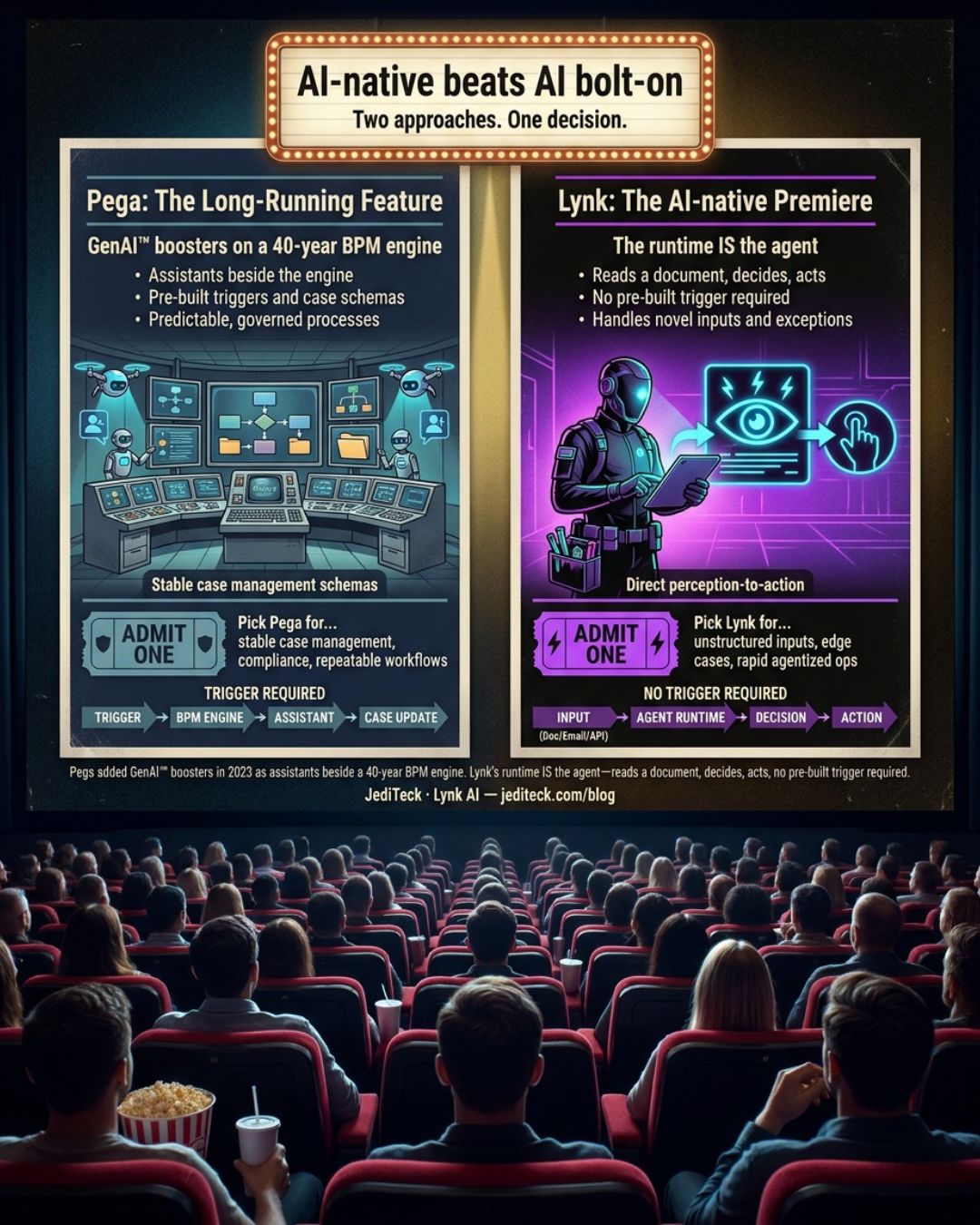
Pega is a deep case-management and decisioning engine with generative AI added on top. Lynk is built the other way around: an agent reasons over your inputs as the core runtime, rather than as a feature sitting beside it. For governed, high-volume processes with stable schemas, Pega wins on maturity and control. For messy inbound work that does not fit a predefined case type, Lynk handles it without someone first modeling the path. The split comes down to one question. Does the AI design your process in advance, or does it reason through the work as it arrives? Pega does the former. Lynk does the latter, and that gap shows up the moment a real input breaks the model.
Where Pega shines
Pega has earned its place in large enterprises. Founded in 1983, it sits at the center of claims and onboarding flows at major banks, insurers, and government agencies. Its Customer Decision Hub drives real-time next-best-action across channels, and few platforms match its depth on case lifecycle, SLA tracking, and audit trails. The model-driven approach keeps logic consistent and upgrade-safe across thousands of users. Compliance teams like that every decision is governed and explainable. When a process is well understood and the cost of an error runs high, that rigor pays for itself. Pega was built for orchestration at scale, and on that ground it remains hard to beat.
How Pega added AI
Pega announced its generative AI push in 2023, then shipped Pega GenAI Blueprint in March 2024. Blueprint is a design-time tool. You describe an application, and it generates a workflow structure you import into the platform as a starting point. Around it sit other boosters: Knowledge Buddy, a retrieval chatbot over your documents, and Autopilot for guided authoring. The pattern stays consistent. AI accelerates how humans design and configure cases, then steps aside while the pre-AI engine runs the process at runtime. The reasoning happens before deployment, baked into a blueprint. That is the textbook bolt-on shape: generative help wrapped around a forty-year-old BPM core.
Where Pega runs out of road
The limits are well documented. Reviewers on G2 and Gartner repeatedly flag a steep learning curve, heavy implementation cost, and a need for certified Pega developers who are hard to hire. They describe the platform as dogmatic and intolerant of deviation, with UI customization fighting the Cosmos design structure. The deeper issue is architectural. Blueprint reasons at design time, so anything it did not anticipate falls back to a human or a hardcoded exception path. Novel input shapes, documents that drift from the expected schema, and multi-step decisions across systems all expose that seam. When the case type does not exist yet, the AI cannot improvise one. Someone has to model it first.
What "AI-native" means in Lynk
Lynk has no AI node to drop into a canvas. The runtime is the agent. When work arrives, the agent reads it, decides what to do, and acts, without a pre-built trigger or a modeled case type waiting for it. Send it an inbound email about a refund that also mentions a second, unrelated issue, and it handles both, routing each one without a branch you drew in advance. There is no design-time blueprint that has to predict the shape of the input. The agent interprets the actual content in front of it and chooses the next step at runtime. Configuration becomes guidance and guardrails, not an exhaustive map of every path the work could take.
The bolt-on tax
The architecture difference stays invisible until the work gets irregular. A blueprint-driven system runs beautifully on the cases it was modeled for and stalls on the ones it was not. Unstructured documents arrive in a layout nobody mapped. A customer request combines two intents that belong to different case types. An exception appears with no predefined handler. In a bolt-on model, each of these becomes a change request: model the new path, test it, deploy it, then the AI can help again. That cycle is the tax. You pay it in developer time and elapsed weeks every time reality produces an input your design did not foresee.
Where Pega still wins
None of this makes Pega the wrong call. If your processes are predictable, your schemas are stable, and your volume is enormous, a modeled engine is an asset rather than a liability. Regulated industries often need exactly that. They want every decision governed, logged, and identical across millions of runs, and they have the budget and the certified team to build it. Pega's decisioning depth and compliance posture are real advantages for that buyer. A blueprint that pins down the process is a feature when the process genuinely should not vary. For a global bank running a fixed claims workflow, predictability beats improvisation, and Pega delivers it.
Decision guide
Pick Pega if:
- Your processes are stable and well understood, with schemas that rarely change.
- You operate in a regulated industry that requires governed, auditable decisions at scale.
- You have the budget and certified developers to model and maintain complex cases.
Pick Lynk if:
- Your inbound work is irregular and often does not fit a predefined case type.
- You need the system to handle novel inputs and exceptions without a fresh modeling cycle.
- You want reasoning at runtime instead of a blueprint that has to anticipate every path in advance.